Aug , 2026 , 21
By Shengmeilai
A cap that looks sharp on the sample table but goes soft and shapeless after two weeks on a retail floor is a problem that traces back to how the wool was blocked and finished, not to the fabric pattern printed on the spec sheet. A well-made wool flat cap beret hat holds its silhouette through repeated handling precisely because the blocking process, the lining construction, and the wool weight were all matched to each other during production, rather than assembled from whichever materials happened to be on hand that week. Buyers evaluating a new supplier for a wool flat cap beret hat program should treat these production details as seriously as the fabric pattern itself, since a striking herringbone print does little for a retail buyer if the cap loses its shape within a season.
A wool flat cap beret hat built from a lighter wool weight drapes softer and suits a more relaxed silhouette, while a heavier weight holds a crisper, more structured shape that better preserves the classic flat cap profile through repeated wear. Buyers sourcing for different retail markets should specify the wool weight range rather than accepting a generic "wool" description, since two suppliers using that same word can ship caps with noticeably different hand-feel and structure once the order arrives.
|
Wool Weight Range |
Typical Feel |
Recommended Climate |
|
Lightweight (under 300 GSM) |
Soft drape, less structure |
Mild spring and fall wear |
|
Midweight (300–400 GSM) |
Balanced structure and comfort |
Standard cool-weather retail |
|
Heavyweight (over 400 GSM) |
Crisp, structured silhouette |
Cold-climate and outerwear pairing |
Herringbone wool fabric gets its texture from a V-shaped weave that has to be cut and aligned carefully across every panel of a wool flat cap beret hat, since a misaligned herringbone pattern is immediately visible to a buyer inspecting a finished sample even though the flaw has nothing to do with the wool quality itself. Factories cutting panels without attention to weave direction produce caps where the herringbone pattern shifts noticeably from one panel to the next, a defect that shows up more in a batch inspection than in a single sample and is worth specifically asking a supplier to check for during quality control.
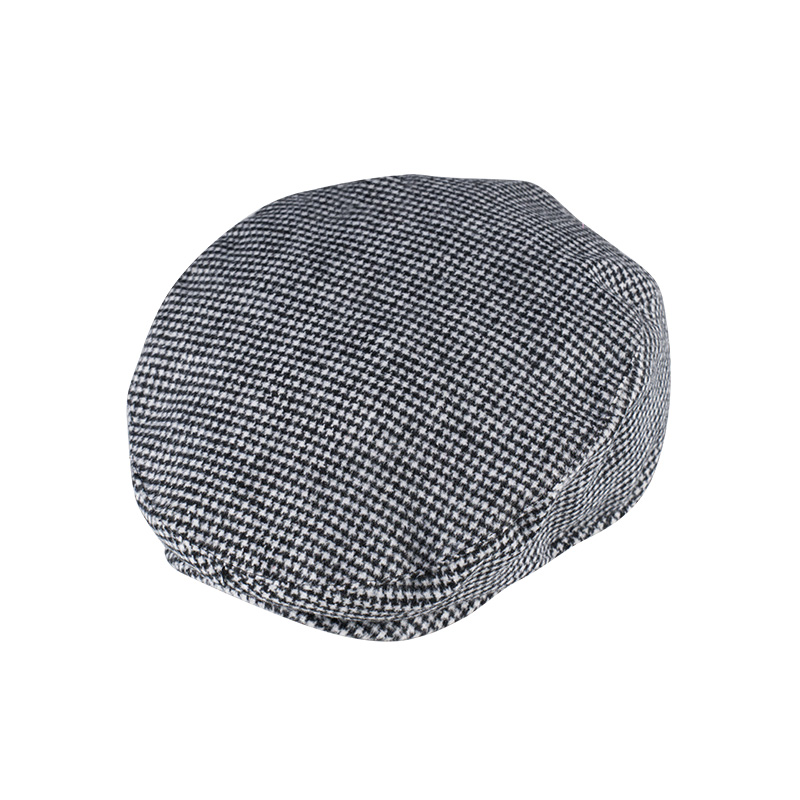
The flat cap lining material used inside a wool flat cap beret hat has to balance breathability against durability, since a lining that traps moisture during warmer wear feels uncomfortable regardless of how well the exterior wool performs. Cotton linings breathe well but wear faster under repeated friction from styling and removal, while polyester blends hold up longer but can feel less comfortable against skin in humid conditions. Buyers should request lining fabric composition alongside the exterior wool specification, since this detail affects the finished product's comfort as much as the visible wool does.
Blocking, the process of shaping the crown of a wool flat cap beret hat over a mold while the wool is still workable, determines whether the finished cap holds its intended silhouette or slowly loses shape after repeated wear and storage. A factory with consistent blocking equipment and trained operators produces caps that retain their shape far longer than one relying on inconsistent hand-shaping across a large batch. Buyers placing bulk orders should ask specifically how blocking is standardized across a production run, since this step is difficult to verify from a single sample but affects the entire shipment's consistency.
Buyers building a private-label program around a wool flat cap beret hat typically need custom color runs, adjusted sizing across a range, or a modified brim shape to differentiate from competing retail offerings, and a factory that builds these requests into its regular production workflow tends to hold consistent quality across the customized run rather than treating each variation as a separate project. Certification covering textile safety standards, such as restricted substance testing relevant to the destination market, should be confirmed before a bulk order of a wool flat cap beret hat ships, since this documentation is what a wholesale buyer's own compliance team will require during import review.
 +86-13606823477
 Hujiaqiao Village, Yuanqiao Town, Huangyan District, Taizhou, Zhejiang, China

 English
 Español