Jul , 2026 , 10
By Shengmeilai
Factories supplying uniform programs across construction, logistics, and agriculture are seeing steady demand shift toward baseball cap with netting styles as buyers rethink summer headwear specs. Procurement teams tied to seasonal safety gear contracts are asking suppliers to quote airflow performance alongside price, and that shift is changing how cutting rooms plan panel layouts for the next production cycle.
A standard six-panel crown traps heat against the scalp once a worker spends six or more hours under direct sun. Mesh side and back panels solve that by opening the crown to cross-ventilation, which is why a baseball cap with netting now shows up on more tender documents from fleet operations and warehouse staffing agencies. Cutting teams at SML Cap Factory report that mesh insertion adds roughly 12 to 15 seconds per unit on the sewing line compared with a solid-panel crown, a small but measurable cost that buyers accept once they see returned-defect rates for heat-related sweat staining drop.
Panel geometry matters here. A mesh back panel stitched too close to the sweatband can pull against the forehead during long shifts, so pattern makers at the factory adjust the curve radius before mesh is cut, not after assembly. That sequencing detail rarely appears in spec sheets, yet it separates caps that hold shape after fifty washes from caps that sag within a season.
Buyers sourcing a baseball cap with netting for industrial use typically pair the mesh with a heavier front panel — cotton twill, brushed cotton, or a poly-cotton blend — so branding and embroidery still sit on a stable surface. The mesh itself runs through pull-tension testing at the factory, where sample panels are stretched on a jig to check recovery after repeated flexing. Panels that lose more than eight percent of their original shape after fifty cycles get flagged before the order moves to bulk cutting.
Color consistency across mesh and twill sections also gets checked under two light sources, since mesh dye uptake differs slightly from woven cotton even within the same color code. Quality staff compare swatches against a Pantone reference before approving a production batch, a step that buyers rarely request but that prevents visible mismatch between crown sections once caps ship.
|
Buyer Type |
Typical Order Size |
Mesh Placement Requested |
|
Construction uniform suppliers |
3,000–8,000 units |
Side and back panels |
|
Agricultural cooperatives |
1,500–4,000 units |
Full back panel |
|
Fleet and logistics operators |
5,000–12,000 units |
Side panels only |
|
Promotional distributors |
500–2,000 units |
Back panel with printed mesh |
Construction-sector buyers tend to lock in orders during late winter, ahead of spring safety-gear rollouts, while agricultural cooperatives place smaller, more frequent orders tied to planting and harvest calendars. A baseball cap with netting ordered for fleet drivers usually specifies a stiffer brim than the version sold to agricultural buyers, since drivers need brim rigidity for glare control during highway shifts.
Embroidery digitizing changes when a design sits partly over a mesh back panel. Needle penetration through open mesh weave requires a backing film that fills the gaps, otherwise thread tension pulls the mesh into visible puckering around the stitched area. Digitizers at the factory run a test stitch on scrap mesh before committing to the full order file, checking stitch density against the mesh's open-weave percentage.
Buyers requesting reflective trim near mesh sections also need to confirm heat-transfer application temperatures, since some ventilated headwear fabrics have lower melt thresholds than standard cotton twill. Running heat transfer at standard settings on a mesh-adjacent seam can distort the weave, so production staff lower press temperature by roughly ten degrees Celsius and extend dwell time slightly to compensate.
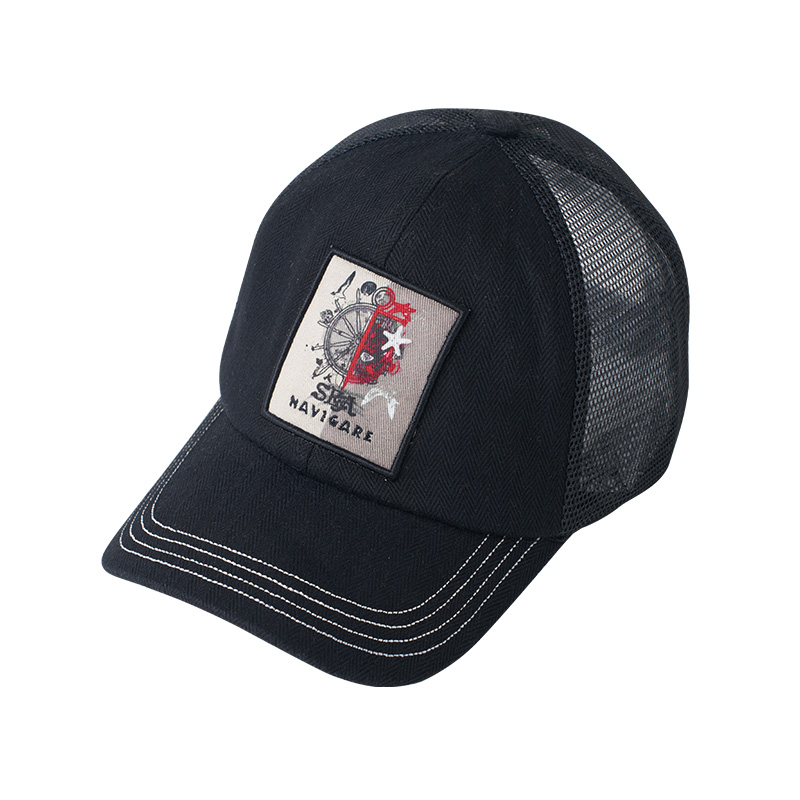
Buyers in humid climates increasingly specify a baseball cap with netting with moisture-wicking sweatbands paired to the mesh crown, treating the two features as a single ventilation system rather than separate specs. Factories quoting these combined builds price the sweatband upgrade and mesh insertion together, since both address the same heat-and-humidity complaint from end users on job sites. Sample approval for a baseball cap with netting order can take longer during peak season, so buyers who confirm mesh color and panel placement early tend to avoid schedule slippage closer to shipment.
Freight timing also shapes when orders for custom cap manufacturing with netting components get placed, since buyers in the Southern Hemisphere run opposite seasonal cycles to those in North America and Europe, keeping mesh-cap production lines active across more months of the calendar year than single-region buyers alone would sustain.
 +86-13606823477
 Hujiaqiao Village, Yuanqiao Town, Huangyan District, Taizhou, Zhejiang, China

 English
 Español