Jul , 2026 , 17
By Shengmeilai
Material selection drives almost every ventilation outcome in headwear manufacturing, and the specific fiber and fabric choices behind a breathable trucker hat determine whether the finished product actually delivers the airflow its mesh panels promise, or simply looks ventilated without performing that way in practice.
Polyester mesh dominates most breathable trucker hat production, chosen primarily for its ability to hold shape through repeated washing while still allowing consistent air passage through the weave structure. Does nylon mesh offer a meaningful alternative? Nylon tends to feel slightly softer against the skin and dries a touch faster after moisture exposure, though it can lose shape retention faster than polyester under repeated stretching from an adjustable snapback closure, which is why many factories default to polyester for the structural mesh panels while reserving nylon blends for softer interior components.
Cotton-polyester blends appear less frequently in mesh panels specifically, since cotton fiber absorbs moisture rather than wicking it away, working against the ventilation goal a breathable trucker hat is meant to achieve. Where does cotton still play a role in these products? Front panels on certain trucker hat styles retain cotton or cotton-blend fabric for its printability and structured look, while the mesh back panels handle the actual ventilation function, splitting material roles across the crown rather than relying on one fabric type throughout.
Front panel structure relies on foam or buckram inserts to maintain the classic trucker hat silhouette, and material choice here affects breathability indirectly by influencing how much heat builds up beneath the structured front panel. A structured foam panel with an open-cell texture allows some air exchange even through the front section, compared to a denser closed-cell foam that blocks airflow more completely. Which hat styles benefit most from open-cell foam? Hats intended for extended outdoor wear in warm climates typically specify open-cell foam over closed-cell alternatives, prioritizing ventilation over the slightly crisper shape retention that closed-cell foam provides.
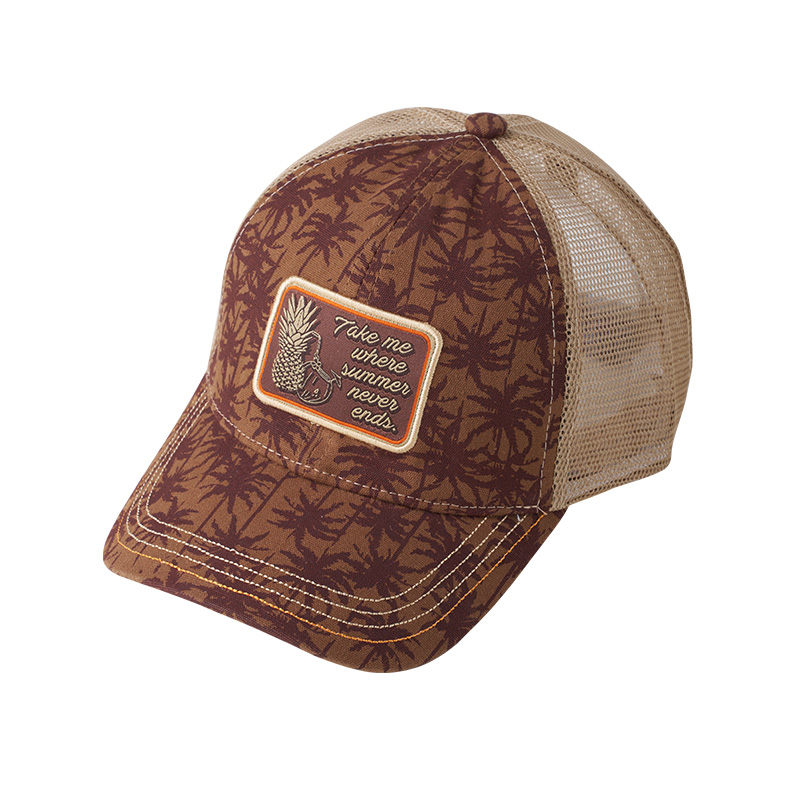
Interior lining materials affect comfort as directly as the visible mesh panels do. A moisture-wicking sweatband made from synthetic microfiber or treated cotton blend pulls perspiration away from the skin more effectively than untreated cotton alone, and this component often determines how a breathable trucker hat actually feels during the first hour of wear, before airflow through the crown has fully offset initial heat buildup from body contact.
Thread choice at panel seams plays a smaller but measurable role in ventilation performance. Which stitching approach affects airflow at seam junctions? Looser stitch tension along mesh panel seams can slightly increase airflow at those junctions, though factories balance this against seam durability, since overly loose stitching risks premature seam failure under the stress of repeated wear and adjustable strap tension. A breathable trucker hat built for heavy daily use, such as work or outdoor labor applications, typically prioritizes tighter, more durable seam construction even if it means marginally less airflow at the seam line itself, trading a small ventilation gain for meaningfully longer product lifespan across repeated wear cycles.
Snapback, buckle, and hook-and-loop closures do not directly affect airflow, but material and placement choices here influence how the crown sits against the head, which in turn affects how effectively air circulates beneath the hat. Where does closure design matter most for ventilation? A closure positioned too tightly against the back mesh panel can compress that panel's structure slightly, reducing its effective air permeability compared to a closure design that maintains consistent spacing between the adjustable strap and the mesh panel surface behind it, a detail that becomes more noticeable across extended wear than it appears during a brief fitting.
 +86-13606823477
 Hujiaqiao Village, Yuanqiao Town, Huangyan District, Taizhou, Zhejiang, China

 English
 Español