Aug , 2026 , 07
By Shengmeilai
A distressed camo trucker hat that looks perfectly worn-in on the sample piece can turn out patchy, overly faded, or unevenly textured once a factory scales that same finish across a few thousand units, and the gap between the two almost always comes down to how tightly the wash and distressing process is controlled rather than anything wrong with the base fabric.
Achieving a convincing worn-in appearance on a distressed camo trucker hat typically involves an enzyme or stone wash process that softens the fabric and lightens the printed camo pattern in a controlled way. Wash timing that varies even slightly between production batches produces caps with noticeably different fade levels sitting side by side in the same shipment, since the enzyme reaction continues as long as the caps remain in the wash bath. Manufacturers running precise timing controls and consistent water temperature across every wash cycle produce a far more uniform distressed look than a process relying on operators eyeballing when a batch looks "done."
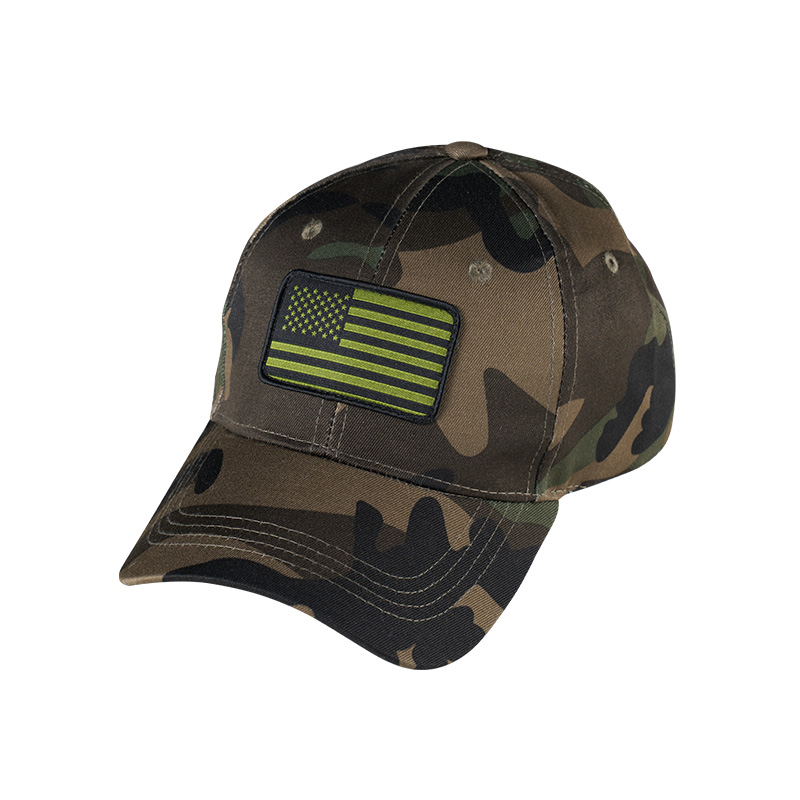
Distressing a solid-color cap fades the fabric evenly across the whole surface, but a camo mesh trucker cap with a multi-color printed pattern fades each ink color at a slightly different rate during the same wash cycle, since darker pigments and lighter pigments absorb the wash chemistry differently. A factory that hasn't accounted for this differential fade risk can end up with a camo pattern where the darker tones have washed out disproportionately, leaving an unbalanced color pattern that looks more like a printing defect than an intentional distressed style. Buyers should ask suppliers whether camo print distressing has been tested specifically against the exact ink set used, rather than assuming a generic distressing process transfers cleanly to a multi-color print.
|
Distressing Factor |
Inconsistent Wash Control |
Precision Wash Control |
|
Fade consistency across a batch |
Varies noticeably between units |
Uniform across the production run |
|
Camo pattern balance after distressing |
Colors can fade unevenly |
Ink colors fade proportionally |
|
Foam panel integrity after washing |
Prone to softening or warping |
Holds structure through the process |
|
Buyer risk on bulk reorders |
Higher, batch-to-batch variation |
Lower, repeatable results |
The foam layer inside a trucker hat's front panel gives the cap its structured shape, and that foam needs to tolerate the moisture and mechanical agitation of a distressing wash without softening or developing an uneven surface texture. A foam front panel cap built with a wash-resistant foam grade holds its shape through the distressing process considerably better than a standard foam meant only for dry-finish caps, and buyers ordering a distressed style specifically should confirm the foam grade has been validated for wet processing rather than assuming any foam panel handles the wash the same way.
Trucker hat mesh backs are typically a finer, more delicate weave than the front panel fabric, and that mesh can develop small snags or irregular texture during an aggressive distressing wash if the process isn't calibrated with the mesh's lower tolerance in mind. Factories running the same wash intensity across both the foam front and mesh back risk damaging the mesh before the front panel of a distressed camo trucker hat achieves the intended worn-in look, so buyers should ask whether distressing parameters are adjusted separately for each material zone on the cap rather than applied uniformly across the whole product.
Buyers requesting private-label distressed styles commonly ask for adjustments to distressing intensity — light, medium, or heavy worn-in look — and patch or embroidery placement relative to the distressed areas, rather than changes to the underlying cap construction. An OEM trucker hat manufacturer offering a small set of standardized distressing intensity levels for a distressed camo trucker hat program, rather than treating every intensity request as a custom process to develop from scratch, can turn around private-label orders faster while still giving buyers meaningful control over the finished look.
Enzyme wash fabric treatment processes leave chemical residue on the finished product unless properly rinsed, and buyers importing a distressed camo trucker hat line into markets with strict textile chemical regulations should confirm that residue testing has been conducted on the actual distressed product, not just on the base undyed fabric before treatment. A supplier that tests finished, distressed units specifically gives buyers more reliable compliance documentation than one testing only the raw fabric input, since the distressing chemistry itself introduces the residue risk that regulatory testing needs to address.
A distressed camo trucker hat style that looks right on an early production run can drift noticeably on a reorder placed months later if the wash timing, water temperature, and chemical concentration used originally weren't documented in writing. Factories relying on an experienced operator's memory of "how we did it last time" introduce more variation between reorders than factories that record exact process parameters and treat them as a repeatable recipe. Buyers placing recurring orders for the same distressed style should ask whether process parameters are documented per style, since this is what actually protects consistency across production runs separated by several months rather than relying on the same staff member still being available to replicate the look from memory.
 +86-13606823477
 Hujiaqiao Village, Yuanqiao Town, Huangyan District, Taizhou, Zhejiang, China

 English
 Español