Oct , 2026 , 16
By Shengmeilai
Black has a reputation as the easy color in headwear because it matches everything and hides stains. On cotton, it carries its own problems. A Black Flat Cap that drifts toward gray or brown after a few washes, or leaves a dark mark on a customer's forehead on a warm day, usually has a dye problem that was decided long before the cap was sewn.
Reaching a deep black on cotton takes a large amount of dye, and any dye that is not firmly bound to the fiber washes out or wears off over time. What the customer sees is a gradual shift: the black turns charcoal, then takes on a warm brown or blue-gray cast, depending on the dye used. A Black Flat Cap in lightweight cotton shows this earlier than a heavier wool cap would, because thin cotton is washed more often and handled more roughly.
Cotton is commonly dyed with reactive dyes, which bond chemically to the fiber, and the quality of that bond depends on the dyeing process and on how thoroughly unbound dye is washed away afterward. A cap factory buying fabric for a Black Flat Cap relies on its fabric suppliers for this step, which makes fabric test results part of the sourcing conversation instead of an afterthought. Buyers who ask for colorfastness reports on the fabric are asking about the stage where many black-cotton problems begin, and one that is hard to correct once the fabric is cut and sewn.
Dark dye that rubs off is a separate issue from fading. A cap sits against the forehead and hairline, where sweat and friction can lift loose dye, and a cap carried in a bag or held in a hand can mark a light shirt. Rubbing tests are usually run dry and wet, with wet rubbing being the harder one to pass. For a Black Flat Cap sold into warm-weather markets, wet rubbing performance matters more than it does for a cap sold only in cold months.
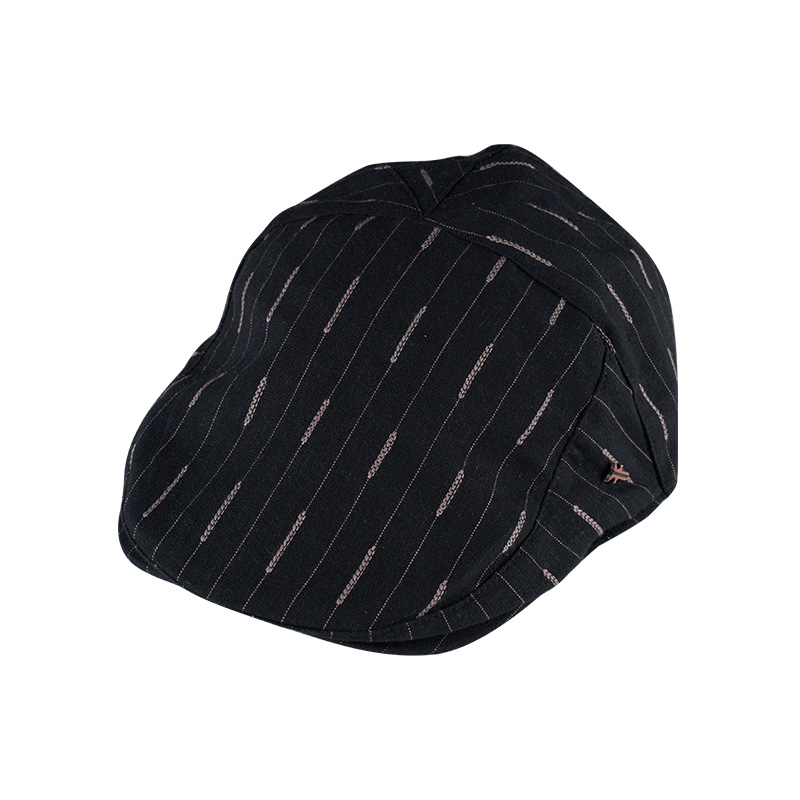
A flat cap has more than one fabric. The outer cotton carries the stripes and the thin stitching, while a soft cotton lining sits against the head. If the outer fabric fades and the lining or the thread does not, the cap develops a visible contrast at the edges and seams. A Black Flat Cap with a striped surface adds a further point to check: tone-on-tone stripes depend on the dark shades staying distinct from one another, and uneven fading flattens the pattern. Matching dye quality across outer fabric, lining, and thread keeps the cap aging as one piece.
Black shows lint and dust more than lighter shades do, and caps stacked on a display shelf or packed in cartons pick up fibers from their packaging. Buyers handling a Black Flat Cap range sometimes specify packaging that keeps loose fibers off the fabric, and a care label recommending cool, inside-out washing helps customers keep the color longer. Individually, these steps are small, and none of them changes the fabric itself, but together they affect how the cap looks on the shelf and after the customer's initial weeks of wear.
For distributors and retailers sourcing this category, useful comparison points include colorfastness results for washing and for dry and wet rubbing, how the outer fabric, lining, and thread are matched for color, whether the band adjusts to different head sizes, and the packaging method. Taizhou Huangyan Shengmeilai Hat Factory, based in Huangyan District, Taizhou, Zhejiang, produces flat caps in cotton and other fabrics, including a lightweight striped cotton style with thin stitching, a cotton lining, and an adjustable band. Buyers comparing a Black Flat Cap across suppliers can request fabric test reports alongside samples, and wash one sample several times at home to see how the color behaves.
 +86-13606823477
 Hujiaqiao Village, Yuanqiao Town, Huangyan District, Taizhou, Zhejiang, China

 English
 Español